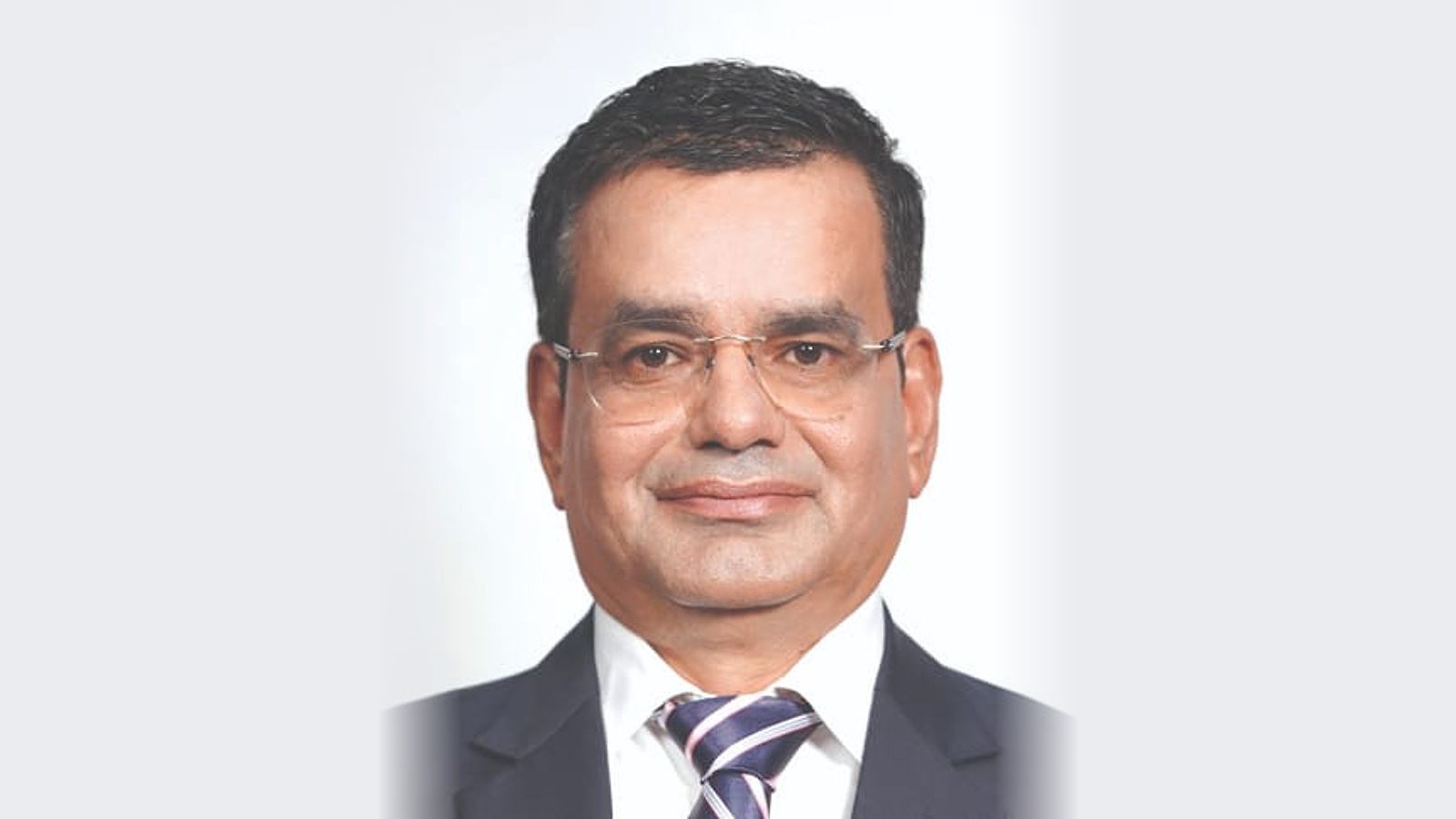
Upendra Mahato's road from Siraha to Moscow and back
He turned $600 into a business spanning Russian electronics, Belarusian machinery and Nepal's first private mobile network, then founded the diaspora association whose split and reunion he has watched from its edge.
In March 2026 the Non-Resident Nepali Association gathered in Kathmandu for a convention organised under the slogan "Our Unity, the Foundation for Prosperity", ShareSansar reported. The man introduced as its founding chairman, Upendra Mahato, used his speech to lament that after 23 years the diaspora was still not fully united, and spoke of an "empty hall", according to Ratopati. The remark carried an edge. Less than a year earlier, The Kathmandu Post had listed Mahato among the senior figures who opposed the court-ordered "unity convention" of May 2025 and stayed away from it.
That a founder should find himself both inside and outside the organisation he created is a small paradox, but it points to a larger one. Mahato built one of the earliest and biggest fortunes made by a Nepali abroad, in the wreckage of the Soviet economy, and then spent two decades trying to turn that fortune and that diaspora into influence at home. For readers in London or Singapore, his story is a guide to how Nepal's economy actually works: much of its capital, and much of its ambition, has been earned somewhere else.
A $600 start in a collapsing empire
Mahato comes from Siraha, in Nepal's southern plains. The Annapurna Express reported that he took an overseer course at Pulchowk Engineering College in Kathmandu before going to Belarus, then part of the Soviet Union, where he studied hydropower engineering. The Record dates his master's degree from the Belarusian State Polytechnic Academy in Minsk to 1988. B360, a Nepali business magazine, reported that he later earned doctoral degrees in soil mechanics from an academy in Minsk.
His business began, by both The Annapurna Express and B360's accounts, with $600 put into electronic goods. The Annapurna Express reported that he was among the first foreigners to register a company in independent Belarus, and that the Belarusian government licensed him in 1993 to import and refine crude oil from Russia. B360 named the vehicle as Syntez, a company that refined crude and sold products in Europe.
By 2004 the scale had changed. Nepali Times, in a piece that year on Nepal's wealthiest expatriates, reported that Mahato's businesses spanned electronics, oil, property, banking and heavy machinery and employed 12,000 people, 50 of them Nepali. He owned a television factory in Voronezh, about 400 km south of Moscow, which the paper said made a million sets a year, and an electronics market at Gorbushka in Moscow that drew 80,000 customers a day. The Record reported that he also bought Amkodor, a Belarusian maker of heavy machinery. He became president of the Russia-Nepal Chamber of Commerce and Industry and Nepal's honorary consul general in Belarus, according to B360.
The phone company that made his name at home
In Nepal, Mahato is known above all for one investment. Spice Nepal launched its mobile service under the Mero Mobile brand in 2005, The Kathmandu Post recorded, as the country's first private mobile operator. The Record reported that Mahato's cash came into the company when it held little more than a licence, and that he partnered with a Kazakh investment group, Visor, which sent a team to Kathmandu in 2005. By the end of 2008, according to The Record, the operator had 1.8 million customers.
The money arrived quickly. The Record reported that two companies it described as apparently controlled by Mahato, one in Cyprus and one in Nepal, held 40% of Spice Nepal, with Visor holding 60%. Under an agreement dated 19 May 2008, The Record reported, the Cyprus company, Daltotrade, sold a 20% stake for $203m to a Visor-controlled company. That price is striking against the business itself: The Himalayan Times reported that Spice Nepal's net sales in 2007 were $41.1m. A few months later, the Swedish-Finnish group TeliaSonera bought 51% of a holding company that owned 80% of Spice Nepal, then the second-largest operator with about 41% of the market, The Himalayan Times reported. The Record put the price at $484m.
Mahato sold his remaining 20% in 2012 to a business associate, Niraj Govinda Shrestha. The Record reported that Mahato told a court he received about $3m, and that Telia lent Shrestha $230m through a Netherlands entity that same year to finance a purchase. Nepal's Large Taxpayer Office accused Mahato of under-reporting the value of the 2012 sale to reduce capital gains tax, and Mahato challenged the office in court, calling its action arbitrary and unfair, according to The Record, which said in January 2021 that the case was unresolved. An accusation by a tax office is not a finding by a court, and no ruling against him has been reported.
The company itself kept changing hands. TeliaSonera renamed Mero Mobile as Ncell in 2010, and in December 2015 Malaysia's Axiata agreed to buy 80% of Ncell for about $1.4bn, The Kathmandu Post reported, describing it then as Nepal's leading telecoms operator. Its subsequent changes of ownership are examined in our report on Ncell.
Hospitals, a bank and a trust named for his mother
Mahato did not keep his Nepali interests to telecoms. In a 2017 profile, B360 listed stakes or roles in Kantipur Television, Machhapuchchhre Bank, Ashwins Medical College and Hospital and several schools and energy companies. B360 also reported that his mother, Phul Kumari Mahato, died of a heart attack after failing to get proper treatment in the village, and that a memorial trust in her name, set up in 2004, runs a hospital in Siraha.
His largest domestic project is a hospital. In December 2017 The Kathmandu Post reported that Nepal Mediciti, in Bhaisipati on the edge of Kathmandu, was running 350 beds with a plan to expand to 750, and quoted Mahato, as its chairperson, promising care to match hospitals "among the best in the world". The aim, B360 reported, is to make specialist treatment affordable for every Nepali, a goal it linked directly to his mother's death.
A founder outside the tent
The organisation that gave Mahato his public role at home was founded in 2003 under the slogan "Nepalis for Nepalis", according to ShareSansar, and The Annapurna Express reported that he held its first global conference in Kathmandu that year. Its leaders claim to speak for eight million Nepalis abroad, The Kathmandu Post reported. That matters because the diaspora is not a sentimental constituency in Nepal: the money it sends home has become a pillar of the economy, as this publication has reported (remittances outran the budget). An association with a claim on that population, and on its savings, is a prize in Kathmandu politics.
It has also been a battleground. The Kathmandu Post reported that the association split in October 2023 after Badri KC won its presidency with 1,378 votes, narrowly ahead of two rivals who rejected the result. Nepal's Supreme Court then ordered a unity convention, which in May 2025 elected Mahesh Kumar Shrestha, while KC's side continued separately; the paper reported that the two factions drew support from different senior politicians. Mahato was among the senior leaders who opposed that convention and did not take part, the Post reported. A unity agreement was finally reached on 30 November 2025 in the presence of Prime Minister Sushila Karki, ShareSansar reported, clearing the way for the March 2026 gathering.
At that gathering, according to Ratopati, Mahato urged non-resident Nepalis to show their capability through action rather than simply advising the government, and called for building a $100bn economy within 10 to 20 years. The target is a measure of how much he believes overseas Nepali capital could do. His own record shows how that capital moves: a fortune assembled in Minsk and Moscow, a Nepali telecoms stake sold through a company in Cyprus, and a hospital, a bank stake and a family trust back home.
B360 quoted him saying that however rich he becomes, he gets "only that much respect as my country receives". For a founder who has watched his own association divide and reunite, it reads less as a slogan than as a measure he has set for himself.
Right of reply: this article draws on published reporting, and The Nepal Standard did not contact the people named for it. Anyone named may send a response to [email protected]; we will publish relevant replies in full or in fair summary, normally within three working days. An arrest, investigation or charge is not a finding of guilt.
How this story was made: researched and written by The Standard’s desk with AI assistance, from the published reporting and official data credited below, and checked against those sources. Our standards.