NEPSE inches up 0.18% as SEBON cuts promoter share-sale notice to five trading days
Turnover fell 18% in the week to 9 October, and only banks gained ground. Now founding shareholders can sell up to 15% of their stakes without warning. Here is what that means for promoters and retail investors.
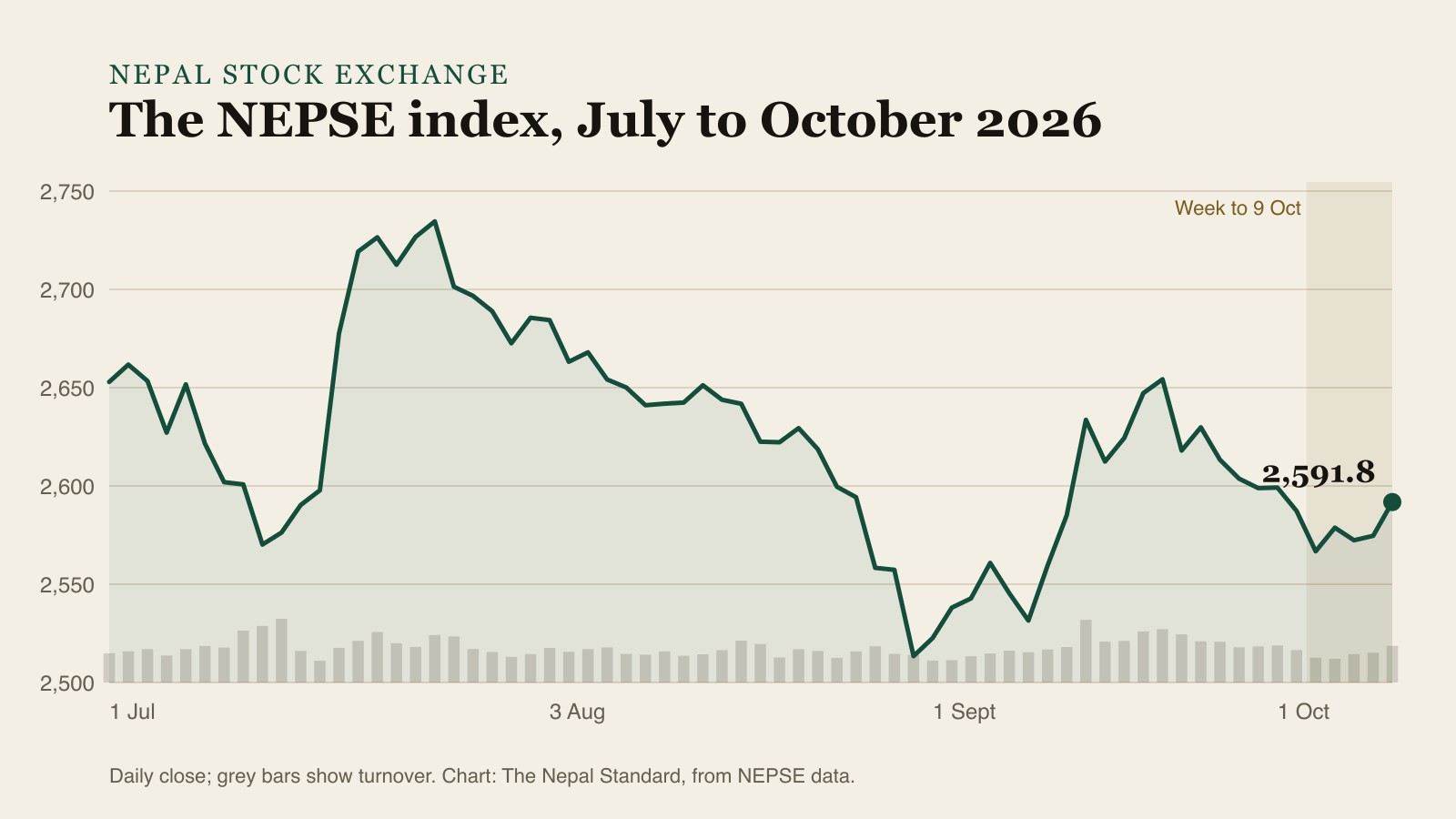
Nepal's stock market ended a four-week losing run in the week to 9 October 2026, but only just, myRepublica reported. The benchmark index of the Nepal Stock Exchange (NEPSE) gained 4.55 points, or 0.18%, over five sessions to close at 2,591.80, The Kathmandu Post reported. Total market capitalisation rose by about Rs 8bn to Rs 4.458 trillion, The Kathmandu Post reported. That followed a Rs 73bn loss in value the week before, myRepublica reported.
On the last day of that week the Securities Board of Nepal (SEBON), the capital-markets regulator, rewrote the rule governing how founding shareholders announce share sales, ShareSansar reported. We set out the full rule change in an earlier story. This piece looks at the market it lands in, and at what a faster, narrower sale notice means for the promoters who sell and the retail investors who buy from them.
A small gain on less money
The index finished higher, but the value of shares changing hands fell. Total turnover for the week dropped 18.1% to Rs 18.44bn from Rs 22.51bn, an average of Rs 3.69bn a day, The Kathmandu Post reported. myRepublica, on its own count, put average daily turnover at Rs 3.787bn, down 21.08% from Rs 4.798bn, the paper reported. On either measure, less money moved through the market than the week before.
The path was uneven. The index swung between a low of 2,557.30 and a high of 2,591.85 and rose on only three of the five days, myRepublica reported.
Subas Chandra Dhungana, an investor and market analyst, linked the slowdown partly to three seasonal pressures, The Kathmandu Post reported. Participation thinned ahead of Dashain, the country's biggest festival. Quarterly interest on margin loans, the borrowed money many retail traders use to buy shares, falls due in mid-October. And mutual funds were selling to manage their quarterly net asset values, the Kathmandu Post reported.
Banks carried the week
Only a narrow slice of the market did the lifting. The banking sub-index climbed 1.52% to 1,517.25, the best sectoral performance of the week, The Kathmandu Post reported. Trading and manufacturing and processing each lost 0.35%, microfinance 0.86% and investment companies 0.88%, the paper reported. Nine sectors closed lower and four higher, with non-life insurance shedding 76.99 points, myRepublica reported.
Hydropower supplied most of the activity at the level of single stocks. Ghalemdi Hydro turned over Rs 1.25bn, with more than 4.4m shares traded, while Himal Dolakha Hydropower and Peoples Hydropower were also heavily traded, The Kathmandu Post reported.
Large volume in a few hydropower names says little on its own about whether buyers are building positions or sellers are cashing out, the Kathmandu Post noted. The technical readings were similarly undecided. The Relative Strength Index, a momentum gauge, stood at 48.69, close to its neutral reading of 50, and the Moving Average Convergence Divergence indicator pointed to flat-to-negative momentum, The Kathmandu Post reported.
What the new notice rule does
The revised rule covers basic shareholders, the founding or promoter holders who owned shares when a company went public through its initial public offering, ShareSansar reported. Once their lock-in period has expired, they must notify the company at least five trading days before selling 15% or more of their own holding, according to ShareSansar. Under the earlier directive, the trigger was a sale of 5% or more, and the notice period was 15 days, ShareSansar reported.
The company must still publish each notice through NEPSE as soon as possible, and a declared intention to sell stays valid for three months, ShareSansar reported. SEBON also added a duty to report purchases by holders who announced a sale but did not complete it, ShareSansar reported.
- 1Basic shareholder plans to sell 15% or more of own holding after lock-in
- 2Notifies the company at least five trading days in advance
- 3Company publishes the notice through NEPSE
- 4Declared intention to sell stays valid for three months
Source: ShareSansar
What it means for promoters
For founding holders, the change removes friction in two ways. Smaller disposals, below 15% of a holder's stake, no longer need an advance public notice at all, ShareSansar reported. Larger ones now carry a notice period counted in trading days rather than the 15-day window that applied before, according to the same report. Because one period is counted in trading days and the other was not, the two are not directly comparable.
The old rule had been unpopular. At a three-hour meeting with SEBON officials on 7 October, investor representatives argued that shares bought on the secondary market should not be treated like founder shares, ShareSansar reported. They said applying the rule to such purchases had set off panic selling and contributed to a sharp fall in share prices, according to the same report. The revised wording ties the duty to holdings from the time of the public offering, ShareSansar reported.
What it means for retail investors
For smaller investors, the trade-off runs the other way. Fewer sales will be announced in advance, so a promoter trimming a stake below the 15% mark can do so without a public signal beforehand. Retail traders who used those notices as a warning of coming supply will have to rely more on prices and volumes.
Against that, a notice that does appear now points to a larger block, which may make each one more informative. The new purchase disclosure also means a holder who announces a sale and then buys instead must say so.
What the rule cannot do is create demand. Dhungana said the change could help sentiment, The Kathmandu Post reported. But he set the market's recovery conditions in terms of buyers, not sellers: a gradual rise was possible if institutional investors returned and daily turnover went above Rs 5bn, according to the Kathmandu Post. That threshold is about 35% above the week's Rs 3.69bn average. He described the index's hold near 2,600, a level the Kathmandu Post described as psychologically important, as encouraging, while adding that a lasting recovery depended on heavier turnover and wider participation across sectors, The Kathmandu Post reported.
What to watch
Daily turnover is the first test. A sustained move above the Rs 5bn a day that Dhungana named would show buyers returning after Dashain, rather than a market drifting on thin trade.
Breadth is the second. A gain led by banks alone is fragile; advances spreading into microfinance, manufacturing and investment stocks would give the index firmer footing.
The third is the 2,600 level. Holding near it once mid-October margin-loan interest has been paid and mutual funds have finished their quarterly rebalancing would remove two of the pressures Dhungana identified.
Finally, watch the NEPSE notice board. The number and size of promoter sale notices filed under the 15% threshold over the coming weeks will show whether founding holders treat the revised rule as an opening to sell, and how much new supply retail buyers will need to absorb.
How this story was made: researched and written by The Standard’s desk with AI assistance, from the published reporting and official data credited below, and checked against those sources. Our standards.
The long view The Nepal Stock Exchange
The long view Nepal's hydropower, from load-shedding to exports