NEPSE ends a nervous week flat as a share-sale notice rule rattles investors
A Friday rally rescued the index, but the regulator's 15-day notice rule for large sellers remains the market's main worry before the Dashain holiday.

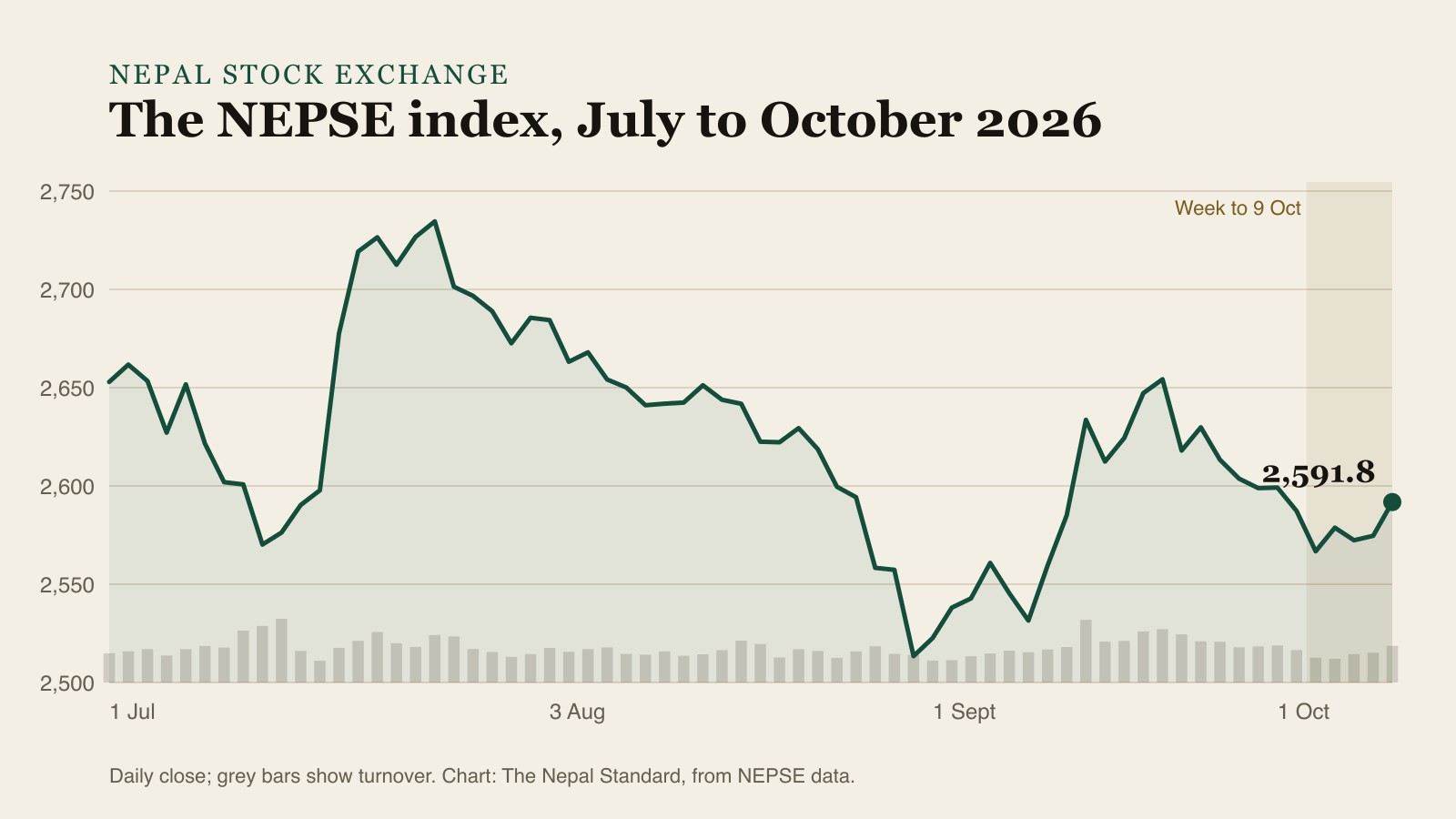
Nepal's stock market finished the week almost exactly where it began, but the route was uncomfortable. The benchmark NEPSE index closed on Friday 9 October at 2,591.80, according to Khabarhub, a gain of 4.55 points on the previous Friday's close of 2,587.25. Most of that came in the final session, when the index rose 17.15 points on turnover of Rs 4.83bn (about $31m). All 13 sector sub-indices ended the day higher, and 180 of the 279 companies traded advanced.
The week had opened badly. On Monday the index fell 20.48 points to 2,566.76, with 242 companies down and only 32 up, Nepal News reported. Turnover shrank to Rs 3.27bn. The paper attributed the weakness partly to the usual price adjustments of dividend season and partly to a new rule from the Securities Board of Nepal (SEBON) requiring large shareholders to announce sales in advance.
Midweek trade was thin. The index slipped 6.39 points on Wednesday to 2,572.34 on turnover of Rs 3.75bn, and added 2.31 points on Thursday on just under Rs 4bn. Friday's rebound took it back towards the 2,600 level it lost late last month.
The rule investors dislike
The directive, issued in late August under the Securities Act, obliges any substantial shareholder of a listed company who intends to sell 5% or more of their holding to notify the company at least 15 days before the sale. The company must then publish the notice through the stock exchange. In a concept paper released in late September, SEBON argued that the requirement would strengthen surveillance, help it spot abnormal price moves caused by large block sales and give all investors the same information at the same time.
In practice the notices have become a stream of sell signals. In September, for example, ShareSansar reported that nine major shareholders of Emerging Nepal Limited had told the company they planned to sell about 1.22m shares over the following three months. Similar announcements have appeared for several hydropower and investment companies. Each notice tells the market that a large block of stock is coming, and prices tend to adjust before the shares arrive.
Pressure for a rewrite
Investor groups took their complaints directly to the regulator on 6 October. According to ShareSansar, representatives of the Nepal Shareholders Association and the Nepal Stock Market Investors Association argued that the rule had been applied to shares bought on the secondary market, not only to founders' and promoters' holdings, and that this had triggered panic selling. They asked SEBON to distinguish between the two, and suggested a shorter seven-day notice period, a separate bulk-trading or offer-for-sale window for large promoter blocks, and a public register of holders above the 5% threshold.
SEBON officials responded favourably and said amendments would be considered, ShareSansar reported, with a formal board decision expected once the board's chairman returns from World Investor Week events. No change had been announced by Friday's close.
What to watch
The regulator's dilemma is real. As lock-in periods on promoter shares expire, founders who want to cash out are entitled to do so, and SEBON's concept paper cites international practice in support of advance disclosure. But in a market dominated by retail investors with small portfolios, a public warning of a large sale can move prices more than the sale itself. A mechanism that routes big blocks through a dedicated window, as investors propose, would address both concerns.
Dashain, Nepal's largest festival, is approaching, and trading usually thins over the holiday period. Friday's breadth was encouraging. But until SEBON clarifies the notice rule, rallies are likely to meet sellers.
How this story was made: researched and written by The Standard’s desk with AI assistance, from the published reporting and official data credited below, and checked against those sources. Our standards.
The long view The Nepal Stock Exchange