Nepal halved its tax on share profits months after raising it, and the harder reforms are still ahead
A 21-point plan to revive NEPSE has cut capital gains tax to 3.75% and 5%. Margin trading, a new index and access for Nepalis abroad depend on deadlines that start this month.

On 29 May, presenting the budget for the 2026/27 fiscal year, the government raised the tax on profits from selling listed shares, from 7.5% to 10% for holdings of a year or less and from 5% to 7.5% for longer holdings, The Kathmandu Post reported. On 22 September the cabinet cut those rates to 5% and 3.75%, according to ShareSansar, the Kathmandu market news site. In less than four months the state halved the tax it had just raised.
The reversal is the most visible part of a 21-point plan that the finance ministry issued on 15 September to revive the Nepal Stock Exchange, known as NEPSE, the Kathmandu exchange whose benchmark index of the same name covers all listed equities. The Post reported that the plan came after floods on the Bhotekoshi river damaged listed hydropower projects. Its deadlines run from this month to March 2027, and the earliest of them fall within days. Meeting them is the plan's first test.
A market that kept falling
The NEPSE index reached its all-time high of 3,198.60 on 18 August 2021, and its most recent peak of 3,002.07 on 29 July 2025, The Kathmandu Post reported in May. This year began with a rally. On 22 March the index rose 54.51 points to close at 2,931.55, with turnover of Rs 23.59bn (about $152m) in a single session, ShareSansar reported.
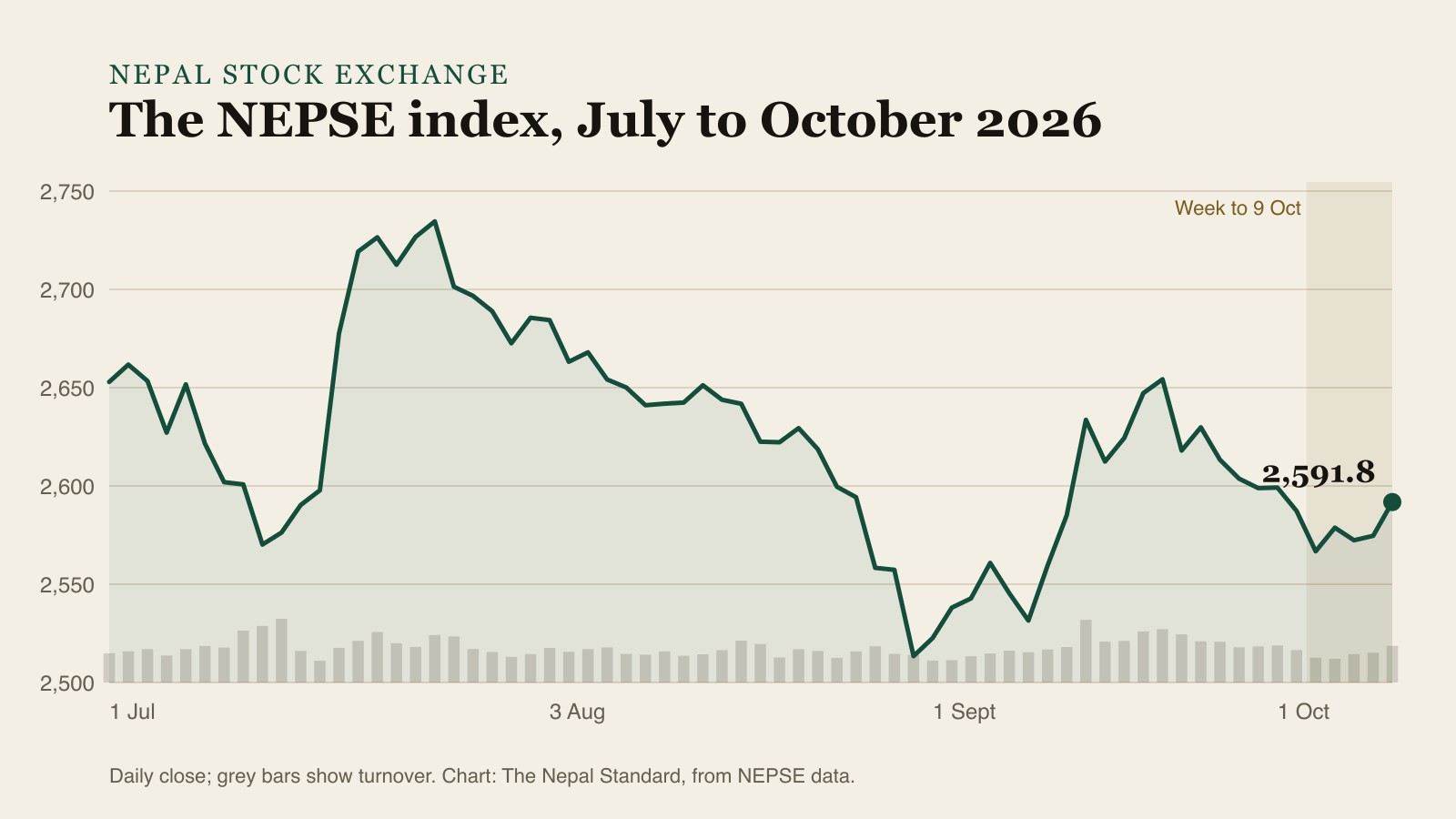
The floods turned a slow decline into a sharp one. On 26 August the index fell 35.92 points to 2,558.35, and all 13 sector sub-indices closed lower, The Kathmandu Post reported. Shares in 252 of the 278 companies traded that day fell. The hydropower sub-index lost 2.84% and the non-life insurance sub-index lost 3.90%, the steepest fall of the day, as investors weighed possible claims on insured projects, the Post said. From the March close, the index had lost about 12.7%. For more on the damage to the power sector, see our report on the Rasuwa flood.
What the 21 points promise
The tax change is the only measure already in force. ShareSansar reported that the cabinet used its power under Section 18(1) of the Economic Act, 2083 to set the new rates, which apply to resident individuals selling securities listed with the Securities Board of Nepal (SEBON), the market regulator, and took effect when the decision was published in the official gazette on 22 September. The plan also proposes that investors be taxed only on their net gains, calculated through the trading and settlement system, rather than on each profitable sale, according to The Kathmandu Post. That answers a complaint made after the budget: the investor and analyst Bishnu Prasad Basyal told the Post in May that the budget's tax treatment was "headline positive but structurally incomplete" because it allowed no offsetting of losses.
The rest of the plan is a schedule of rules still to be written. According to The Kathmandu Post's account of the plan:
- A second index. A new benchmark is due by mid-December, built on tradable shares, market value, financial health, liquidity and governance. The current all-equity index will remain.
- Non-resident Nepalis. Amendments to the Foreign Investment and Technology Transfer Act and the Foreign Exchange (Regulation) Act, needed to let Nepalis living abroad buy and sell listed shares, are due at the cabinet by mid-October.
- Institutional money. Legal and market infrastructure for more investment by the Employees Provident Fund, the Citizen Investment Trust, the Social Security Fund, insurers and mutual funds is due by mid-October, with rules aligned by mid-December.
- Banks. Nepal Rastra Bank (NRB), the central bank, and SEBON are to review by mid-November the limits, risk weights and collateral rules that govern bank investment in shares.
- Bonds. Bond market regulations are to be amended by mid-October, with a framework for green, disaster, social and project bonds.
- Listings. Sector rules for public offerings by hydropower, manufacturing, hotel, agriculture and pharmaceutical companies are due, with legal changes, by mid-January 2027; rules on share consolidation, splits and buybacks by mid-February; and a study of the capacity of CDS and Clearing, the settlement house, by mid-March.
Margin trading, a promise nine years old
The measure with the longest history is margin trading, in which a broker lends an investor part of the price of shares. SEBON issued a margin trading directive in 2017 that was never implemented, Clickmandu reported in February, when the regulator approved a replacement that took effect on 13 February 2026. The new rules require a broker to have paid-up capital of at least Rs 200m (about $1.3m) and to be a clearing member. Investors must put up at least 30% of the market value of the shares and keep a margin of at least 20%. A broker's total margin lending is capped at five times its certified net worth, and no single client may account for more than 10% of its margin book, Clickmandu reported. The 21-point plan sets mid-January 2027 as the date for margin trading to begin through licensed brokers, according to The Kathmandu Post.
Margin lending has already figured in a money-laundering case this year. The Department of Money Laundering Investigation alleges that the businessman Deepak Bhatta diverted about Rs 3.73bn (about $24m) from five listed companies, The Kathmandu Post reported in April. Bhatta has said he had a margin arrangement with Bhrikuti Stock Broking, and the Post noted that no broker in Nepal was then authorised to offer margin trading.
Intraday trading, buying and selling the same share within one session, is moving more slowly. SEBON has chosen to introduce it through subordinate rules and bylaws rather than by amending the Securities Act, and plans three phases: drafting the rules, upgrading the NEPSE trading engine and broker systems, and a pilot limited to selected Class A companies, Clickmandu reported on 9 October. Only "buy first, sell later" trades will be allowed at first, because the exchange settles trades two days after the deal and lacks systems for same-day risk control. Niranjaya Ghimire, SEBON's spokesperson, told Clickmandu that work was under way but that the regulator could not commit to a launch date. For the detail, see our report on the phased rollout.
What the market has done since
The tax cut has not yet lifted prices. In the week to 3 October the index fell 30.66 points to 2,599.15, all 13 sub-indices declined, and market capitalisation fell to Rs 4.47 trillion (about $28.8bn), The Kathmandu Post reported. Average daily turnover dropped 26.47% to Rs 4.50bn.
The regulator has meanwhile relaxed one of its own recent rules. On 9 October SEBON raised the threshold at which founding shareholders must announce a planned sale from 5% of their holding to 15%, and cut the notice period from 15 days to five trading days, ShareSansar reported. Shareholders who announce a sale and then do not complete it must now disclose any purchases. For the background, see our earlier coverage of the disclosure rule.
Four dates will show whether the plan holds. The first is mid-October, when the amendments for non-resident investors and the bond and institutional investor rules are due. The second is mid-November, for the central bank and SEBON review of bank investment in shares. The third is mid-December, for the new index. The last is mid-January, when margin trading is meant to start. For how the exchange works, see our NEPSE explainer, and for daily prices see our NEPSE page.
How this story was made: researched and written by The Standard’s desk with AI assistance, from the published reporting and official data credited below, and checked against those sources. Our standards.
The long view The Nepal Stock Exchange
The long view Nepal's hydropower, from load-shedding to exports