How Nepal's stock market works: NEPSE, Meroshare and the 8m-account investor base
A plain-English guide to a small, retail-driven exchange: who can invest, how Meroshare and brokers work, what this year's tax and trading-rule changes mean, and why banks and hydropower dominate.
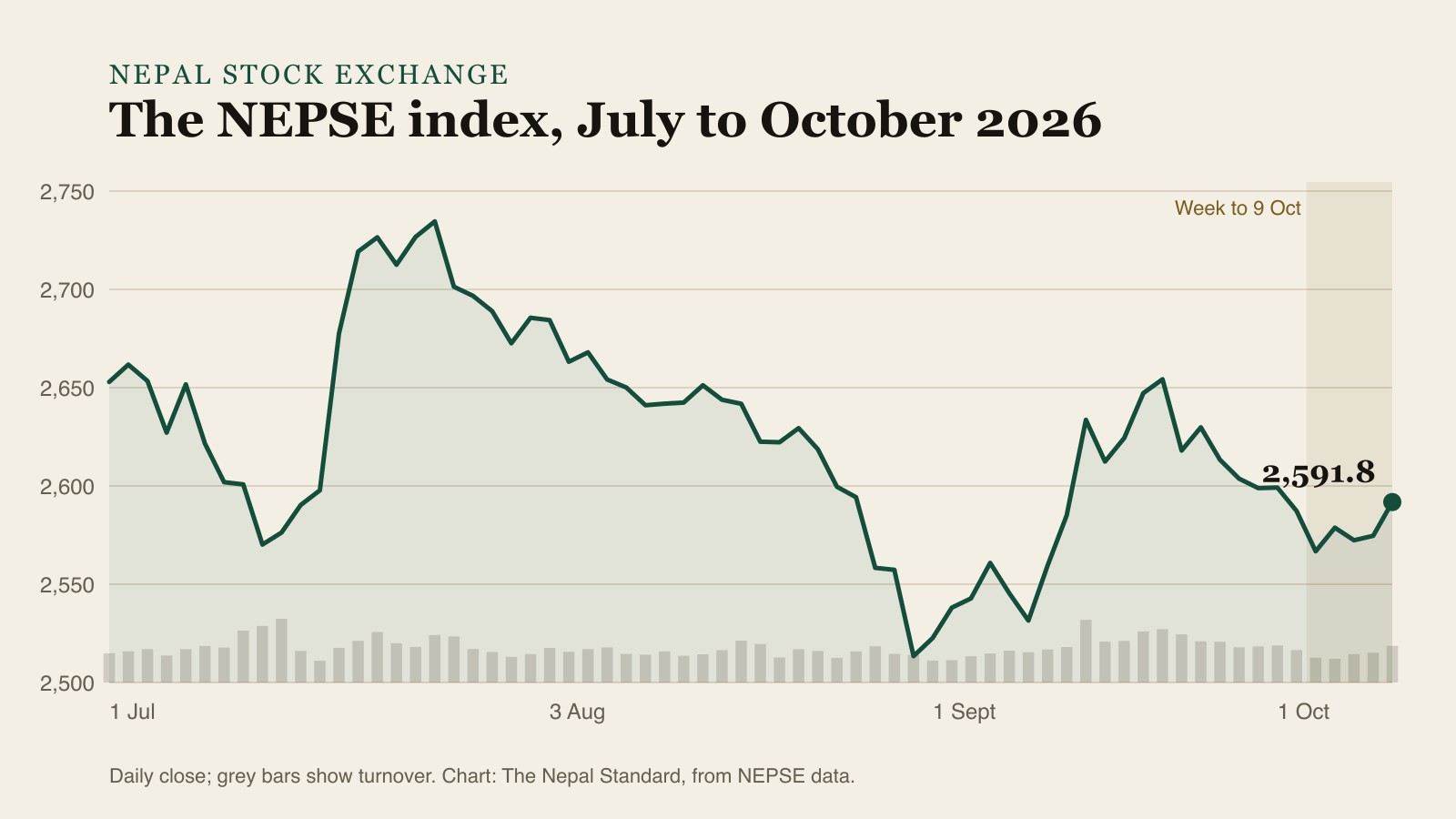
By global standards, the Nepal Stock Exchange (NEPSE) is small. On 1 October its listed companies were worth Rs 44.70 kharba in the Nepali counting system, about Rs 4.47trn or $29bn, and a full day's trading in 353 companies turned over Rs 4.89 arba, roughly $32m, according to ShareSansar, a Nepali market news site. By Nepali standards it is enormous. The Securities Board of Nepal (SEBON), the market regulator, told parliament's finance committee on 30 September that about 8.1 million demat accounts, the electronic accounts in which shares are held, had been opened, ShareSansar reported.
That combination, a modest market with a mass following, is the key to understanding NEPSE. It is built by and for Nepali households, its rules limit how far a price can move in a day, and its index leans heavily on banks and hydropower. For an investor in London or Singapore, the first question is not what to buy but who is allowed to buy at all. This guide explains how the market works, who trades in it, what it costs and what tends to move it. Live prices are on our NEPSE index today page.
A market built for Nepali savers
NEPSE is the country's only stock exchange. It grew out of the Securities Exchange Centre, set up in 1976, which the government converted into the Nepal Stock Exchange in 1993; the exchange opened its trading floor on 13 January 1994, according to NEPSE. It remains majority owned by the state: the government holds 58.66%, and the state-owned Rastriya Banijya Bank (11.23%), the Employees Provident Fund (10%) and Nepal Rastra Bank (NRB), the central bank (9.5%), hold most of the rest, NEPSE's shareholder list shows. SEBON regulates the exchange and approves new share issues.
- Government of Nepal58.66%59%
- Rastriya Banijya Bank11.23%11%
- Employees Provident Fund10%10%
- Nepal Rastra Bank9.5%10%
- Laxmi Bank and Prabhu Bank10%10%
- Others0.6%<1%
Source: Nepal Stock Exchange
Most investors are individuals, and the numbers have grown quickly. Of the 8.1 million demat accounts SEBON reported, 5.12 million were active on Meroshare, the online portal of the central depository, and 3.56 million investors held trading accounts with brokers at the end of the last fiscal year, according to ShareSansar. Some people hold more than one account, so the number of distinct investors is lower, but the reach is wide.
Money from abroad has barely entered. In October Nepal opened a legal route for companies to issue shares in foreign currency to non-resident Nepalis (NRNs) and foreign citizens of Nepali origin, ShareSansar reported. Under the Securities Registration and Issuance (Eighth Amendment) Regulations, eligible companies may sell between 10 and 85% of their issued capital this way, in minimum trading units of 1,000 shares and without a premium, and investors are meant to be able to take their returns abroad in foreign currency. The accounts and trading systems are still being built by NRB, SEBON, NEPSE and CDS and Clearing (CDSC), the central depository. The route is aimed at the Nepali diaspora; ShareSansar's report describes no equivalent opening for other foreign investors. For now, then, NEPSE is a domestic market that outsiders can watch more easily than they can join.
From Meroshare to the trading screen
A resident Nepali investor needs two accounts. The first is a demat account opened through a depository participant, usually a bank or broker, which links to Meroshare. Run by CDSC, Meroshare is where shares are held electronically and where investors apply for initial public offerings (IPOs). Because it is the gateway to new issues, many people open an account only for that purpose (see our piece on Nepal's IPO lottery). Upcoming offerings are listed on our securities issues and IPOs page, and the backlog awaiting approval is examined in our report on the 111 issues queuing at SEBON.
The second is a trading account with a licensed broker. Orders on the secondary market go through the Trading Management System (TMS), the online platform through which brokers take buy and sell instructions. NEPSE says it has 92 member brokers.
Then there is tax, which has changed twice this year. The budget presented on 29 May raised capital gains tax on shares to 10% for holdings of less than a year, from 7.5%, and to 7.5% for longer holdings, from 5%, ShareSansar reported. Four months later the government reversed course. Since 22 September, when the cabinet's decision was published in the Nepal Gazette, resident individuals have paid 3.75% on gains from shares held for more than 365 days and 5% on shorter holdings, according to ShareSansar. The cut forms part of the finance ministry's plan to revive the market, which we have examined in detail.
Rules that keep prices on a leash
The trading week itself moved this year. When the government gave the country a Saturday and Sunday weekend, NEPSE followed: from the week of 6 April it has traded Monday to Friday rather than Sunday to Thursday, with hours unchanged at 11:00 to 15:00, Ratopati reported. A short pre-open session comes before the main session.
Prices are capped. Since 20 April a single share can rise or fall by no more than 15% in a day, up from 10%, and prices set in the pre-open session can move by up to 5%, up from 2%, according to ShareSansar. The market also has two circuit breakers. If the index moves 5% within the first two hours, trading pauses for 15 minutes; a move of 8% at any point closes the market for the rest of the day. ShareSansar reported that the limits were widened to reduce frequent trading halts while giving investors more room when momentum is strong.
Some familiar tools are missing. Investors cannot yet buy and sell the same share on the same day, and there is no short selling or securities lending. SEBON has set out a four-stage plan to introduce margin lending, intraday trading, securities borrowing and covered short selling, as we have reported.
Banks, rivers and the national mood
What the index measures is, above all, the health of finance. Nepal Rastra Bank data for mid-March 2025, reported by B360, showed that banks, other financial institutions and insurers made up 130 of 268 listed companies and 53.2% of total market value. Hydropower accounted for 91 companies and 15.7%, investment companies for 7.6% and manufacturing for just 5.4%. That concentration means the index tends to move with bank shares, and that buying the index is, in large part, buying exposure to Nepal's lenders.
The second-largest sector brings a different kind of exposure, to weather. On 26 August, the morning a major flood struck Rasuwa district north of Kathmandu, the NEPSE index fell 35.92 points to 2,558.35, The Kathmandu Post reported. The hydropower sub-index fell 2.84% on early reports of damage to projects in and around Rasuwa, and the non-life insurance sub-index fell 3.90% because insurers cover those projects and faced the prospect of large claims. All 13 sector sub-indices closed lower, and 252 of the 278 companies traded fell, according to the Post (see our report).
Policy moves the market too, as this year's tax reversal shows: the government raised capital gains tax in May and cut it below its old level within four months, in an effort to revive trading. A change to the weekend, a widening of price limits and a new route for the diaspora all arrived within the same six months.
For an outsider, that is the most useful way to read NEPSE. It is less a gauge of corporate profits across a broad economy than a reading of how Nepali households, banks and policymakers feel about the country's prospects, expressed through a narrow set of mostly financial and hydropower shares. The two developments that would change its character most are the ones still in progress: a working channel for diaspora money, and the trading tools SEBON has promised. Both are worth following on our NEPSE index today page and in our coverage of securities issues and IPOs.
How this story was made: researched and written by The Standard’s desk with AI assistance, from the published reporting and official data credited below, and checked against those sources. Our standards.
The long view The Nepal Stock Exchange
The long view Nepal's hydropower, from load-shedding to exports