Cosmic Air Nepal: how the first private jet airline rose and fell
Cosmic Air put the first jets on Nepal's domestic routes and flew to Delhi, Dhaka, Kolkata and Varanasi. Fare cuts, fuel debts and lease arrears grounded it within two years, and the regulator cancelled its certificate in 2010.
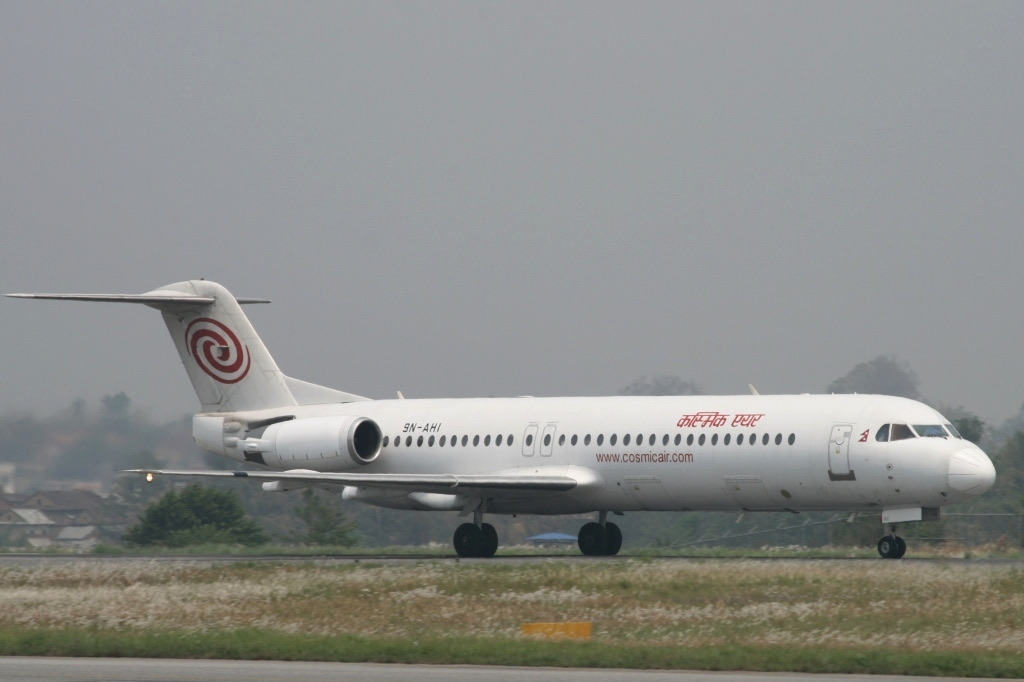
In late October 2004 a 105-seat Fokker 100 touched down in Biratnagar, and Nepal's domestic aviation changed overnight. Until then, private flying inside the country meant turboprops and small twin-engined aircraft; Cosmic Air had just put the first jet on a domestic route, Nepali Times reported. Within six months the airline would claim half of the country's air travel market, The Himalayan Times reported. Within two years its jets would be parked at Tribhuvan International Airport at the request of their owners, The Himalayan Times reported. The story of how a private carrier rose that fast and fell that hard remains one of the clearest lessons in Nepali business about the cost of growth bought on credit.
From helicopters to jets
Cosmic Air was founded in 1997 by Captain Rabindra Prasad Pradhan, a veteran pilot, after the state carrier and other airlines could not meet demand for seats, The Annapurna Express reported. By November 2000 the company flew two Mi-17 helicopters, four Dorniers and a growing fleet of Swedish-built SAAB 340 turboprops, with new services planned to Bhairawa and Nepalgunj, Nepali Times reported.
Its leap came with a licence. The Civil Aviation Authority of Nepal (CAAN), the regulator, had picked Cosmic Air for an international operating licence by November 2003, on condition that it fly at least one jet to regional destinations, mainly in India, within a year, Nepali Times reported. At that point the airline was operating only one of its SAAB 340s, the same report said.
Cosmic met the deadline. It took its first Fokker 100 on a dry lease, meaning the airline bore the cost of maintenance, crew and insurance, and launched jet services to Biratnagar, Bhairawa and Nepalganj, Nepali Times reported in its issue of 29 October 2004. Pradhan said he chose the Fokker for its short take-off performance and its low fuel use per passenger mile, the same report said. He also set out his view of the risk: the business was safe "if government policy is consistent", with proper regulation and no unfair competition, Nepali Times reported.
Half the market in six months
On 1 December 2004 Cosmic Air became the first private Nepali carrier to fly between Kathmandu and Delhi, running two flights a day alongside a twice-weekly service to Dhaka, Nepali Times reported. A second Fokker arrived the same week, and the airline spoke of Pokhara, Bangalore, Bangkok and Bombay as the next destinations, the same report said.
Price was the weapon. By April 2005 Cosmic Air was selling one-way Kathmandu to Delhi tickets for Rs 2,400, forcing Royal Nepal Airlines Corporation, the state carrier, to offer fares of Rs 3,000 to Rs 4,500, while Indian Airlines charged Rs 4,300, The Himalayan Times reported. Cosmic called itself a budget airline and denied it was waging a price war, describing the fares as an introductory marketing strategy, the same report said.
Growth followed quickly. A fourth Fokker 100 landed at Tribhuvan International Airport in May 2005, giving the airline seven aircraft, and the company said it held 50% of the country's market, The Himalayan Times reported on 28 May 2005. Flights to Kolkata began on 8 July 2005 and to Varanasi on 9 July, each three times a week, with an introductory "buy one, get one free" offer, The Himalayan Times reported. By then Cosmic was flying to Delhi twice a day and to Dhaka five times a week, the same report said.
The turn
The fares that filled the planes did not cover the bills. Late in 2005 the airline halted domestic flights for a week until it paid Rs 5m toward its fuel debt, and by late December it owed more than Rs 85m to Nepal Oil Corporation, the state fuel monopoly, and nearly Rs 10m to CAAN for ground handling, Nepali Times reported on 23 December 2005. It was also behind on lease payments to AerCap, the Fokkers' lessor, and staff, including pilots, had gone three months without pay, the same report said.
The fleet was shrinking from the inside. Two of the four jets were grounded and being stripped for parts to keep the others flying, and one engine was in the United States for a $1m overhaul, Nepali Times reported. Twelve of the 17 banks the airline approached for loans turned it down, the same report said. Its general manager, a former Singapore Airlines manager in Kathmandu, called the problems temporary and disputed some of the arrears, Nepali Times reported.
Nepal had seen this pattern before. Necon Air, an earlier private carrier, had left its two ATR-42 aircraft to rot on the tarmac for more than a year before a deal to dismantle them for parts, after failing through what Nepali Times described as financial mismanagement, the paper reported in the same December 2005 article.
The fall
The decisive blow came from the lessors. At 5pm on 18 May 2006 CAAN grounded two of Cosmic Air's Fokkers at the request of AerCap Ireland and AerCo, which cited default on payments and on the lease agreement, The Himalayan Times reported. Upendra Karki, the airline's marketing director, said the company would go to court and insisted it had been paying the leasing companies regularly, the same report said. No court ruling on that dispute has been reported in the sources we reviewed.
One jet remained for international flights, The Himalayan Times reported. In October 2006 that aircraft was also grounded with a technical fault, and the airline suspended all domestic and international flights, The Himalayan Times later reported. Cosmic Air returned on 17 October 2007, almost a year later, with 14 weekly flights to Delhi at Rs 8,000 one way and daily flights to Biratnagar and Nepalgunj, The Himalayan Times reported. Its vice-chairperson promised an upgraded service, the same report said.
The revival did not last. On 11 January 2010 CAAN annulled the air operator certificates (AOCs) of Cosmic Air, Yeti International and Impro Airways, all of which had stopped flying at least a year earlier, after they failed to renew their operating licences, Republica reported. Cosmic Air still owed Rs 6.5m, and its Fokker had been grounded at Tribhuvan International Airport since 2006, the same report said. "The AOCs were annulled as these airline companies did not show any interest to renew their operating licences," Keshavraj Khanal, CAAN's director general, told Republica.
- Founded by Captain Rabindra Prasad Pradhan
- First jet on a domestic route, a Fokker 100 to Biratnagar
- First private Nepali carrier on Kathmandu to Delhi
- Fourth Fokker 100 arrives; the company claims half the market
- Fuel debts, unpaid salaries and jets stripped for parts
- Regulator grounds two jets at the lessors' request
- Last jet grounded; all flights suspended
- Air operator certificate annulled
Source: Nepali Times, The Himalayan Times, Republica, The Annapurna Express
What it left behind
Cosmic Air proved that Nepalis would fly in large numbers if the price was right. It brought jets to domestic routes, put a private Nepali flag on Indian routes, and pushed rivals to cut fares, The Himalayan Times and Nepali Times reported at the time. Those were real gains for passengers.
It also showed how thin the margin for error is in Nepali aviation. Every input that matters, from fuel to airport charges, is sold by a state body that can stop supply, and jets leased from abroad can be grounded on the lessor's word. An airline that funds growth with unpaid suppliers rather than equity has no buffer when a single engine fails. When the banks said no, Cosmic Air had nowhere left to turn, as the December 2005 reporting showed.
The questions Cosmic raised have not gone away. Nepal's domestic carriers still compete on thin margins and volatile fuel costs, as our report on falling domestic air passengers and rising fares sets out, and the country's regulator still faces scrutiny over how it oversees airlines, covered in our piece on splitting CAAN and the EU air safety list. For more collapses of once-dominant Nepali firms, see our Ledger.
Right of reply: this article draws on published reporting, and The Nepal Standard did not contact the people named for it. Anyone named may send a response to [email protected]; we will publish relevant replies in full or in fair summary, normally within three working days. An arrest, investigation or charge is not a finding of guilt.
How this story was made: researched and written by The Standard’s desk with AI assistance, from the published reporting and official data credited below, and checked against those sources. Our standards.