Nepal IPO approvals stall: 117 firms wait on Securities Board
One company has won clearance since 15 April 2026, while 117 applicants seek Rs 71.13bn and a hydropower association and company founders complain of repeated paperwork and open-ended waits.
A company can have a net worth per share of Rs 263.61, well above the Rs 100 face value of its shares, and still not be allowed to sell a single share to the public. That is the position of several applicants in Nepal's primary market, where approvals have become rare.
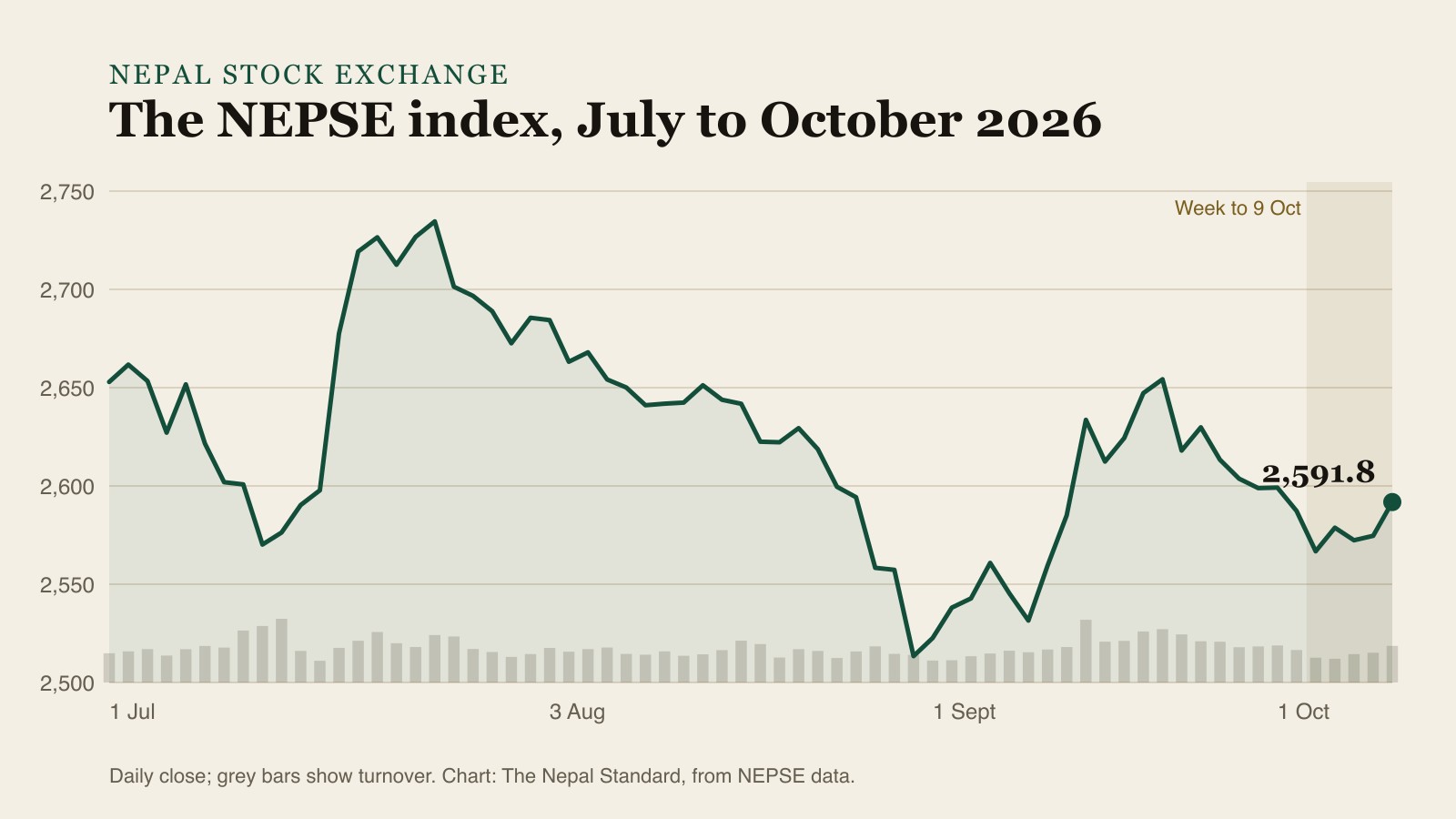
The Securities Board of Nepal (SEBON), the market regulator, cleared one company to issue an initial public offering (IPO) on 6 October 2026. It was the only approval since 15 April 2026. In the meantime 117 companies have applied to raise a combined Rs 71.13bn (about $467m at the central bank's rate of Rs 152.23 to the dollar) through 510 million shares.
The regulator's case
The board's explanation is procedural: applicants have not completed the required steps. Merchant bankers, who manage the applications, have been asked for updated details on 76 of the 117 companies. A dozen companies have submitted every document, and nine have met the newest requirement of net worth per share of at least Rs 100.
Those nine are Sanima Hydropower, IME Limited, Richet Hydropower, Him River Power, Hilton Hydropower, Habitat Power, NC Agrotech, Ashutosh Energy and Kantipur Pharmaceuticals. All seek to issue at face value, and their net worth per share runs from Rs 105 to Rs 263.61. Meeting the test is not the same as clearance: it is uncertain when any of them will receive approval, and the board says it must still carry out its own assessments.
The board's spokesperson, Niranjay Ghimire, says paperwork alone is not enough because the information must be verified, and some projects are inspected in the field. Chairperson Gopal Prasad Bhatt says an IPO does not suit every company, particularly those whose business is tied to a fixed period.
The hydropower question
Bhatt's sharpest doubt concerns hydropower. After 30 years a project passes to the government, and he asks what then becomes of the company and of the shares held by the public. The board will no longer approve just any hydropower company, and those meeting its published criteria will be cleared.
This matters because hydropower is the sector the state is counting on. The government has set a target of 30,000 megawatts within 10 years. Mohan Kumar Dangi, president of the Independent Power Producers' Association, Nepal, says some completed plants are still waiting, and that companies built expected IPO proceeds into their investment plans. His suggestion is blunt: if the board does not want hydropower IPOs, it should say so.
There is a second cost. Under the regulations, hydropower firms must set aside a share of their issued capital, up to 10%, for people living in areas affected by their projects. Those shares can be sold only after IPO approval, so withheld approval also withholds local ownership.
Founders push back
One founding shareholder complains of resubmitting updated statements each time a new financial year begins, only to see them left pending again. The shareholder says the company became public after manufacturers were encouraged to enter the capital market, yet now faces the same procedural hurdles.
Since 2016, real and manufacturing companies have been able to list with a public offering of only 10% of their shares, a rule designed to bring more manufacturers onto the market. Banks, financial institutions and insurers face a heavier requirement of 30%, and three microinsurance applications are pending.
What it means
A regulator that screens applications closely can protect small investors, and Bhatt says the board is now focused on updating its regulatory framework, some of whose earlier provisions may need amending. But a queue that barely moves carries costs of its own. Firms that cannot sell equity may lean on other financing or delay projects.
The uncertainty may be the larger problem. The criteria have been published, yet it is unclear when the nine firms that meet the net worth test will hear a decision. Capital planning depends on predictability, and an open queue makes it harder.
What to watch
- Whether the nine firms that meet the net worth test are approved, and in what order.
- The board's revised regulatory framework, and any specific rules for hydropower companies.
- Whether merchant bankers clear the backlog of 76 incomplete applications.
- Whether the 10% local allotment for project-affected residents can proceed once approvals resume.
How this story was made: researched and written by The Standard’s desk with AI assistance, from the published reporting and official data credited below, and checked against those sources. Our standards.
The long view The Nepal Stock Exchange
The long view Nepal's hydropower, from load-shedding to exports