Nepal bank stocks hit two-year high as Sanima profit doubles
NEPSE's banking index has reached a two-year high, with investors drawn by low valuations and hopes of loan recoveries. Sanima's profit jump and Standard Chartered's smaller dividend show the picture is uneven.
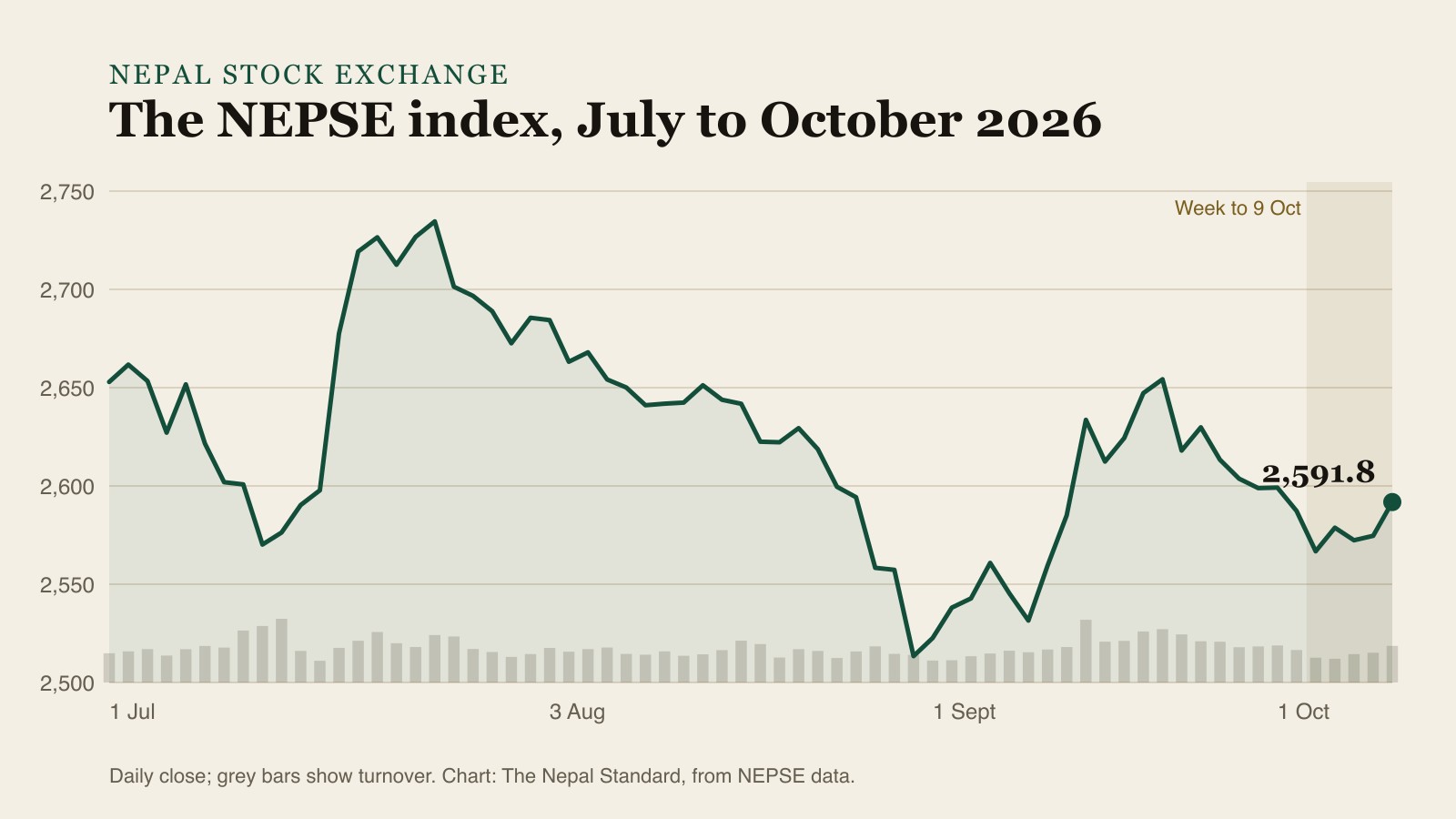
Here is a puzzle in Nepal's stock market. Sanima Bank more than doubled its quarterly profit while its deposits and lending barely moved and its interest margin shrank. Meanwhile bank shares as a group are the best performers on the Nepal Stock Exchange (NEPSE).
It had been at 1,426 on 26 August 2026, a gain of 10.93% in two months. The broader NEPSE index rose 4.14% over the same period.
One bank's results cannot explain a whole index. But Sanima shows what investors may be hoping for across the sector: lower charges for bad loans.
Sanima shows the mechanism
In the first quarter of 2026/27, to mid-October 2026, Sanima's net profit rose 131.13% to Rs 1.05bn, from Rs 454.9m in the same quarter of 2025/26. The figures are unaudited.
Most of that gain did not come from selling more. The bank set aside Rs 330.97m for potential credit losses, against Rs 956.77m a year earlier. Net interest income rose a more modest 9.42% to Rs 1.84bn, and fee and commission income grew 46.86% to Rs 447.8m.
Source: Clickmandu, Sanima Bank unaudited financial statement
Asset quality improved to match. Its non-performing loan ratio fell to 2.86% from 3.91%, and net of provisions to 1.08% from 1.58%. Provision coverage rose from 105.46% to 136.71%, meaning the cushion held against bad loans now exceeds the bad loans themselves.
Annualised earnings per share climbed from Rs 13.15 to Rs 29.17, and the stock trades at 13.47 times earnings.
Growth is not the story
Sanima's balance sheet barely moved. Deposits grew 2.08% to Rs 254.10bn over the quarter and lending rose 1.78% to Rs 199.36bn. Its credit-to-deposit ratio is 79.23%.
Margins are thinner. The interest spread narrowed to 3.17% from 3.65%, as the base rate fell from 5.59% to 4.60% and the cost of funds from 4.32% to 3.35%. Falling rates have cut what the bank pays for money, but also what it earns on it.
A bank can lift profit without growing if the drag from bad loans eases, and Sanima's results hint that, for at least one lender, that drag may be lifting. It is one bank and one quarter, so other banks' results would be needed before calling a sector trend.
Why investors are buying
Tulsi Ram Dhakal, president of the Nepal Investors Forum, said bank shares attract buyers partly because they have the lowest price-to-earnings ratios, which makes them look cheap. He added that institutions tend to prefer long-established firms with steadier businesses and a history of dividend payments.
Some bank stocks have gained more than 25% over the period. Laxmi Sunrise Bank led, rising 25.86% from Rs 216.90 to Rs 273.
- Laxmi Sunrise25.86%
- NMB15.36%
- Prime Commercial15.13%
- Agricultural Development14.49%
- Investment Mega13.14%
- Kumari12.94%
- Nepal Bank12.62%
Source: Online Khabar
Prices for banks that have announced dividends are adjusted for those payouts, so raw price changes understate what shareholders earned.
The dividend picture is uneven
Payouts are mixed. Siddhartha Bank declared 20% (10% cash, 10% bonus shares). Everest Bank declared 15% (10% cash, 5% bonus) and Nabil Bank 15.8% (10.8% cash, 5% bonus). Sanima declared a 10% cash dividend, while Global IME declared 10% (6% cash, 4% bonus).
Standard Chartered Bank announced a 16% cash dividend on 27 October 2026. Its previous payout was 19%. The payout needs approval from Nepal Rastra Bank (NRB), the central bank, and the annual general meeting, for which no date is set.
Prasiddha Raj Aryal, deputy chief executive of Machhapuchchhre Bank, pointed to a narrower lending-deposit spread and larger set-asides for bad loans as the reasons dividends have shrunk. He said provisions are not permanently lost. In his words, the money "remains on the balance sheet" and can benefit investors when recoveries begin.
That is the bet the market appears to be making. Recovered overdue loans can flow back into profit and into distributable profit, which for Sanima stood at Rs 1.99bn at the end of the quarter. Whether that becomes higher dividends will turn on how much is actually recovered, and on each bank's earnings and capital.
What to watch
- First-quarter results from the other commercial banks, to test whether Sanima's fall in provisions is typical.
- Whether interest spreads keep narrowing, which would cap the gains from lower provisioning.
- Loan recoveries, which determine if provisions are released into profit.
- The Standard Chartered meeting date and NRB approval of its payout.
- Whether the index clears its October 2023 level of 1,590.
How this story was made: researched and written by The Standard’s desk with AI assistance, from the published reporting and official data credited below, and checked against those sources. Our standards.
The long view The Nepal Stock Exchange