Nepal gold price hits Rs 284,300 a tola, up 17.72% in a year
Gold has rewarded Nepali holders over twelve months, but a duty rise, a stronger dollar and a bar on bullion trading shape the return, and buyers at the January 2026 peak remain underwater.
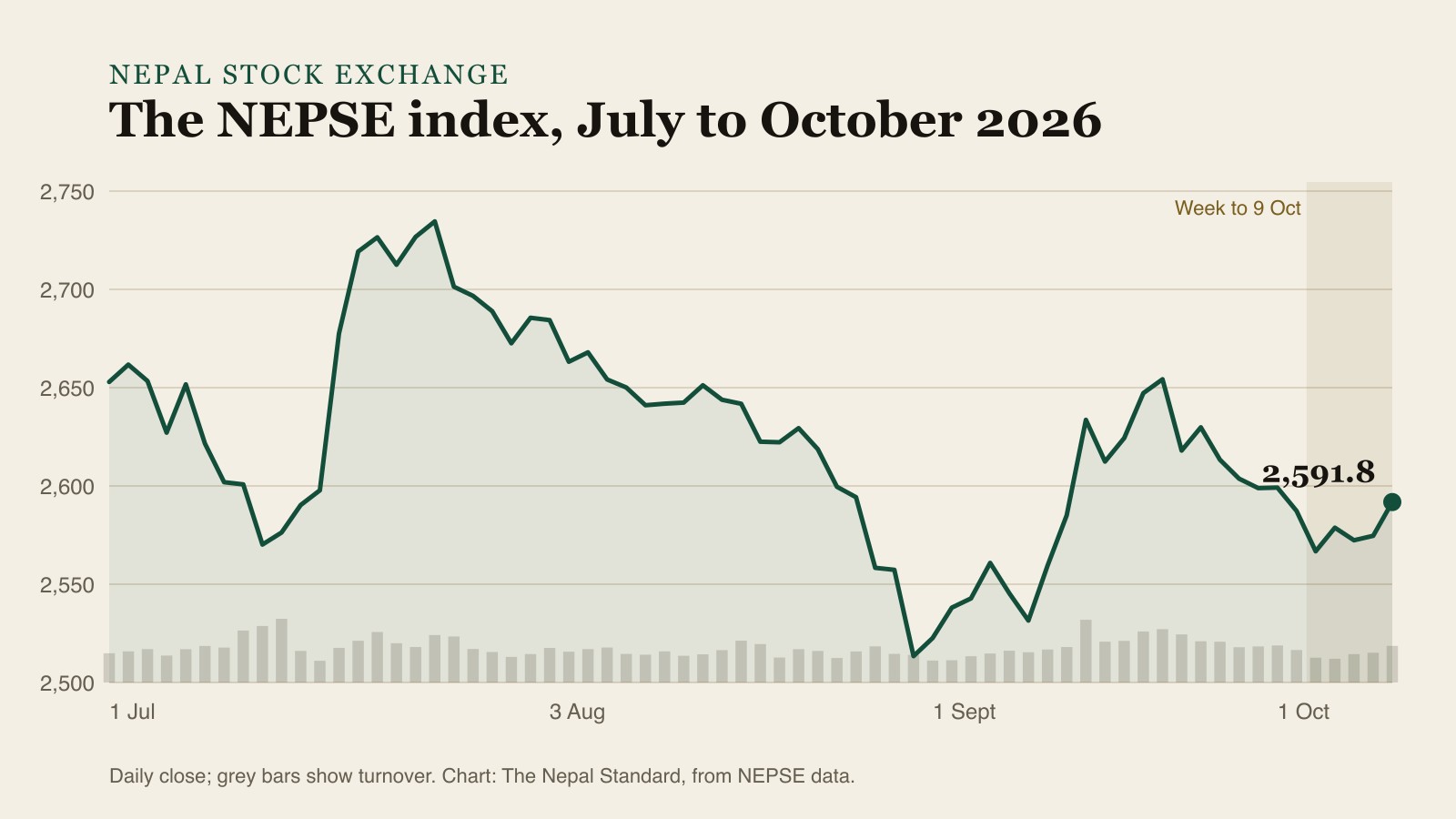
Fine gold costs Rs 284,300 a tola in Kathmandu on 10 November 2026, the local unit of weight used for the metal. The price was Rs 283,000 on Sunday, 8 November 2026, and the dealers' federation raised it by Rs 1,300 in its fixing for Monday, 9 November 2026. It is Rs 55,000 below the price on 29 January 2026, when the metal touched Rs 339,300, the highest ever recorded in Nepal.
Both facts are true at once, and the gap between them is the story. Over twelve months gold has climbed from Rs 241,500 on 10 November 2025, a gain of 17.72%. Yet anyone who bought near the January 2026 peak is sitting on a loss. A single day's rise is less a signal than a reminder of how the market is built.
Why Nepal's gain outran the world's
The 17.72% return looks generous until it is set beside the world price. In the international market, gold rose just 3.54% over the same period. The gap has been attributed to a higher customs duty and a stronger US dollar.
The latest budget doubled the duty on gold, from 10% to 20%. A duty tends to lift the local price when the border charge rises, even if the world price barely moves. The dollar matters because gold is priced abroad in dollars and bought in Nepal in rupees.
Source: Online Khabar
One reading of these numbers is that much of what Nepali holders earned in twelve months came from the duty and the currency rather than from the metal. The gain is real in rupees, but it is not evidence that gold outperformed elsewhere. If the duty were cut or the dollar weakened, the local premium could shrink even with a steady world price.
The peak still casts a shadow
Silver tells the same tale more sharply. It has gained 25.77% in the year, from Rs 3,065 to Rs 3,855 a tola, after a record Rs 7,505 on 29 January 2026. It has since lost Rs 3,650, almost half its peak. Its latest rise was Rs 45, from Rs 3,810 on 8 November 2026.
Gold sits about 16% below its record, silver nearly 49% below. Prices are set daily by the Federation of Nepal Gold and Silver Dealers' Associations, and the Rs 1,300 rise is a move of under 0.5% on a base of Rs 283,000. Set against the fall from the peak, it barely registers. Those who paid elevated prices have learnt that short-term returns from precious metals are far from assured.
Why an investor cannot simply buy gold
Nepal makes the straightforward trade hard. Dharmasundar Bajracharya, first vice-president of the federation, says dealing in raw or bullion gold is illegal, while jewellery can be bought and held.
That channels savings into a costly form. Making and wastage charges can reach 12% of the total price. When a piece is sold back to a trader, the seller receives only the day's market price for the metal, so unless prices rise, those charges become a loss. Plain rings or bangles can carry labour charges below 5%.
Storage and the missing funds
Holding jewellery at home carries the risk of theft. Bank lockers are an alternative, with annual charges starting at around Rs 3,000, rising with size, and a minimum security deposit of Rs 10,000. Even then, compensation is not assured if a major disaster or crisis destroys a locker.
Nepal also lacks a digital route. In India, investors can hold gold through exchange-traded funds, which trade on a stock exchange and track the metal. Nepal offers nothing similar, so anyone wanting exposure to the price must accept making charges, storage costs and security risks.
For a global reader, the point is that Nepal's gold market is a closed system with a thick layer of friction. Domestic prices follow the world price but add a duty and an exchange-rate effect, and the usual financial wrappers are absent. Making charges fall on the holder at purchase, locker fees on storage, and the holder bears the price risk in between.
What to watch
The first test is the direction of the daily price set by the dealers' federation, and whether it can recover any of the Rs 55,000 lost since 29 January 2026. The second is the 20% duty: any change would move the Nepali price independently of world markets. The third is the dollar, which has been cited as part of the domestic premium. Finally, watch whether a legal route, such as exchange-traded units, ever opens for those who today have only jewellery to buy.
How this story was made: researched and written by The Standard’s desk with AI assistance, from the published reporting and official data credited below, and checked against those sources. Our standards.