Buddha Air's Birendra Bahadur Basnet bets on rice despite a Rs 25m mill loss
The Buddha Air chairman believes machines, bank credit and a mill's guaranteed purchase can make the economics of a two-bigha farm work. As of October 2026, the experiment had lost money.
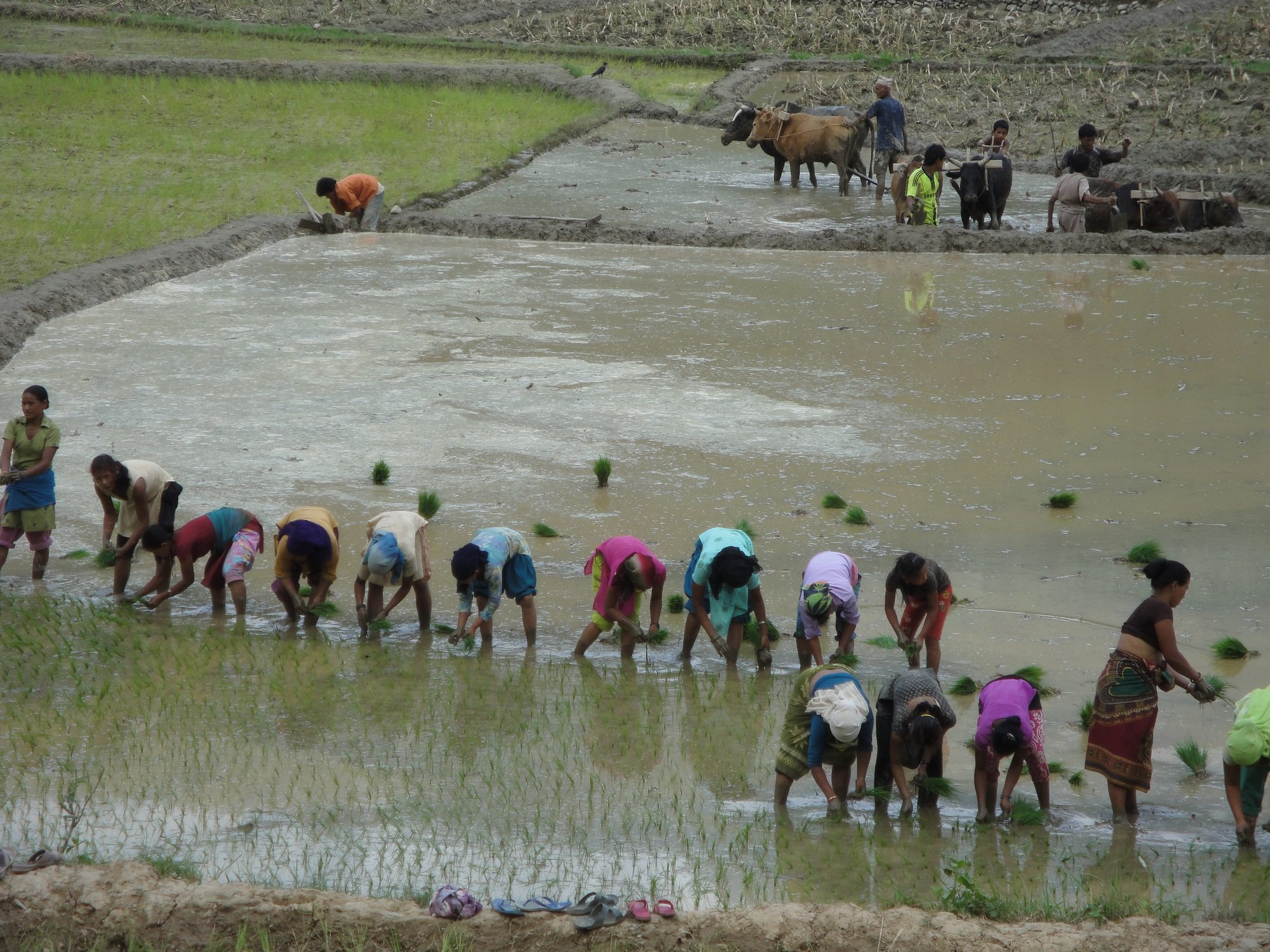
Grain hauled by oxen from the Basnet family fields in Morang once took a night to reach the family store in Biratnagar. Each cart was a bamboo contraption rolling on wooden wheels, with room for roughly 600 kilograms of paddy. A car now covers the same distance in half an hour, Birendra Bahadur Basnet told Kantipur's Suraj Kunwar in an interview published by The Kathmandu Post on 11 October 2026.
The road has shrunk. The economics of the farm at the other end have moved far less. Basnet, executive chairman of Buddha Air, began farming commercially in the mid-1980s, the newspaper reported. He is now pursuing a question that matters well beyond his own balance sheet: can a smallholder with two bigha of paddy earn a living that stands up against a labourer's wage in the Gulf?
His own rice business is, in effect, the test case, and it had not turned a profit by October 2026, he said.
A lesson learned from rotting bananas
Basnet's father bought one of Nepal's first tractors, a Belarus-built machine, and its first thresher. He brought Malbhog bananas from Assam, which thrived, but Biratnagar could not absorb the crop and half of what the family shipped to Kathmandu rotted on the road. A planting of 2,000 coconut saplings fared worse. Fish fry was the exception, with sales of Rs 1.5m to Rs 2m a year by the late 1980s, Basnet told the Post.
The conclusion he drew has shaped everything since. Growing the crop, in his view, is the simple part; selling it is where the money disappears, The Kathmandu Post reported.
That diagnosis matters because of the scale of the problem. Roughly 60% of Nepalis depend on agriculture, and about 1.4m of the country's 1.7m to 1.8m hectares of arable land is under paddy, by Basnet's estimate. With little mineral wealth or industrial base, people either stay on the land or leave the country, he argued. In his view Nepal has the ratio backwards and needs fewer farmers working larger areas with machines, The Kathmandu Post reported.
The anchor model
Basnet's response is what he calls an anchor enterprise built around Arju Rice Mill. The aim is to connect 10,000 bigha of smallholder paddy, bigha being a traditional South Asian land measure, with machinery, bank credit and a guaranteed buyer, the Post reported.
The mill announces a minimum support price before planting. Farmers were wary, Basnet said, and came to trust the price only after the mill had kept its word for two to three years. It also promoted a fine-grain variety bred by a Nepali research council, aimed at Indian jeera masino rather than cheap coarse rice. Some 5,000 bigha near Belbari now sit within 12 or 13 farmer groups, and the mill takes paddy from both the spring and main-season harvests, he said.
Land stays with its owners. A two-bigha holding in the Tarai, the southern plains, is worth Rs 8m to Rs 15m (roughly $52,000 to $98,000 at the central bank's rate of Rs 153.54 to the dollar), and Basnet said any attempt to pool it by force would end in bloodshed. Instead, young entrepreneurs with machines would plough, transplant and harvest across hundreds of bigha on a set timetable, while owners follow the work on an app, he said.
The numbers are substantial. One mechanised transplanter covers about 25 bigha, so 10,000 bigha needs roughly 400 transplanters and 100 harvesters run by about 50 young entrepreneurs: an equipment bill of around Rs 1bn ($6.5m), Basnet estimated.
The financial innovation came later. A mill's promise to buy the crop gives a bank something to lend against, Basnet said. NMB Bank sent its chief executive, deputy and a credit manager to meet him, and Everest Bank has also joined, the Post reported. Growers can draw a cash advance or overdraft before the season, sparing them the village moneylender who charges 2% to 4% a month; once the paddy reaches the mill, the loan rolls over, he said.
- 1Mill announces minimum support price before planting
- 2Bank lends working capital against the mill's guarantee
- 3Young entrepreneurs with machines plough, transplant and harvest
- 4Farmer delivers paddy to the mill
- 5Loan is renewed and the cycle restarts
Source: Birendra Bahadur Basnet, interview with Kantipur's Suraj Kunwar, published by The Kathmandu Post
Enforcement is the obvious weak point. Basnet said the Local Government Operation Act of 2074 BS lets municipalities write rules for arrangements like his, with sanctions for defaulters, and that he is in talks with them.
Where the money went
Basnet is open about the losses. Sales have grown: the mill sold roughly Rs 200m of paddy in one year and roughly Rs 400m (about $2.6m) of rice in the next, the two years before the October 2026 interview, though he did not name the years. Profit has not followed. The more recent of those years ended with an operating loss of about Rs 25m (around $163,000), almost all of it interest paid to the banks, Basnet told the Post.
That interest bill came on top of a bruising trade. The mill had bought 10,000 tonnes of paddy at Rs 50 a kilogram, prices then collapsed, and the rice was sold at a loss at Rs 73 a kilogram. Storage added a technical error: 1,200 tonnes of spring paddy went into store at 15% moisture, two points above the safe level, and grew mould, he said.
Distribution proved hard too. Basnet said he had once promised to cut out middlemen and now calls that "hard", because reliable distributors were slow to emerge. Separately, about Rs 30m to Rs 40m was stuck with one distributor until police stepped in and the money began to return, he said.
For the year under way at the time of the October 2026 interview, which he did not define further, Basnet set targets of 20,000 tonnes, about Rs 1bn in sales and a profit of around Rs 150m (about $977,000), The Kathmandu Post reported.
Source: Birendra Bahadur Basnet, interview with Kantipur's Suraj Kunwar, published by The Kathmandu Post
Harvests can be insured, Basnet noted, and in his account agriculture carries little inherent hazard; what can go wrong is the chain linking the field to the store and the buyer. Aviation, by contrast, is exposed to the dollar, fuel costs, spare parts and the market, and loses passengers whenever roads are open, he said. By his own framework, the price collapse and the damp storage he linked to the mill's troubles belong to that chain rather than to the fields.
Does two bigha pay?
The social case rests on a simple sum. At the mill's minimum support price, Basnet estimates net profit of about Rs 200,000 per bigha, or Rs 400,000 a year for a typical two-bigha Tarai household. That works out at Rs 32,000 to Rs 33,000 a month, about what a Gulf worker earns, with poultry, goats and a cow adding Rs 5,000 to Rs 10,000, he said. His own verdict is measured: remaining on the land leaves a family roughly level with going abroad, though hardly well off, the Post reported.
The ambition is larger still. With Madhesh Province preparing tenders for mills, Basnet plans one of about 100,000 tonnes a year supported by around 20,000 bigha. Farmers would hold 40% to 50%, Nepal Krishi Company about 10%, and institutional investors the remainder; he named the Social Security Fund, insurers, the IFC and the ADB as candidates. Buddha Air would have no involvement, and the Basnet side would stay on as anchor shareholders, he said.
He also sees follow-on industries in rotation crops such as mustard, maize and potato, and in feed mills, oil mills, hatcheries and cold storage. With El Niño causing Indonesia's paddy to fail, he argued, whoever secures food supply will win, The Kathmandu Post reported.
What to watch
The first test is whether the mill reaches the 20,000-tonne, Rs 150m-profit target Basnet set in October 2026, which would show the model can survive a price shock. The second is whether local governments adopt default rules that give lenders such as NMB and Everest the confidence to expand guarantee-backed credit. The third is the Madhesh mill tender, and whether development lenders and the Social Security Fund will take stakes in a processor where farmers would hold 40% to 50% alongside the Basnet side as anchor shareholders. If those pieces fall into place, the paddy field could become a new line of lending business for Nepal's banks.
How this story was made: researched and written by The Standard’s desk with AI assistance, from the published reporting and official data credited below, and checked against those sources. Our standards.



