Nepal's banks lift profit 6% as lending stays weak
Banks and financial institutions grew profit by 6.11% in the first two months of 2026/27, helped by fee income, short-term investments and old-loan recoveries, while credit demand stays subdued.
Eight of Nepal's commercial banks earned more than Rs 1bn each in just two months. Seven of the 20 saw profit fall. That is the contradiction at the centre of Nepali banking in 2026/27: earnings are rising while the lending business that normally produces them is stuck, a pattern familiar to investors watching banks in other markets awash with cash and short of borrowers.
The figures come from Nepal Rastra Bank (NRB), the central bank, and cover Shrawan and Bhadra, the first two months of the Nepali fiscal year, to mid-September 2026. Banks and financial institutions earned a combined net profit of Rs 19.46bn, up 6.11% from Rs 18.34bn in the same period of 2025/26. The 20 commercial banks accounted for Rs 17.81bn of that, a rise of 7.32% from Rs 16.60bn. At the central bank's rate of Rs 151.44 to the dollar, the two totals are roughly $128m and $118m.
Source: Nepal Rastra Bank data
Earnings without growth
A banker would normally expect profit to follow lending. Here it has not. Demand for long-term project loans is subdued, and the financial system holds more lendable money than borrowers want. Lending rates have fallen as a result, which narrows the gap between what banks pay depositors and what they charge borrowers. That gap, the net interest margin, is the core of a bank's income.
The profit gain therefore came from elsewhere. Banks placed funds in short-term investments, pressed hard to collect old non-performing debts, and earned more in fees. Bankers attributed the fee and commission income to higher imports, trade-finance activity, remittance inflows and more digital banking.
This is a useful result, and a cautionary one. Recoveries of old loans and fee income are real money, but neither is a substitute for a growing loan book. Fees tied to imports and remittances depend on trade and household flows that banks do not control.
The bad-debt burden
Non-performing assets remain a drag. Lenders must set aside earnings as provisions against loans that borrowers are failing to service, and a weak economy has made repayment harder for households and businesses, which pulls income away from profit.
On top of that, thinner margins and sluggish borrowing leave banks earning less on their assets than they would like, even with so much surplus cash in the system.
Who is winning
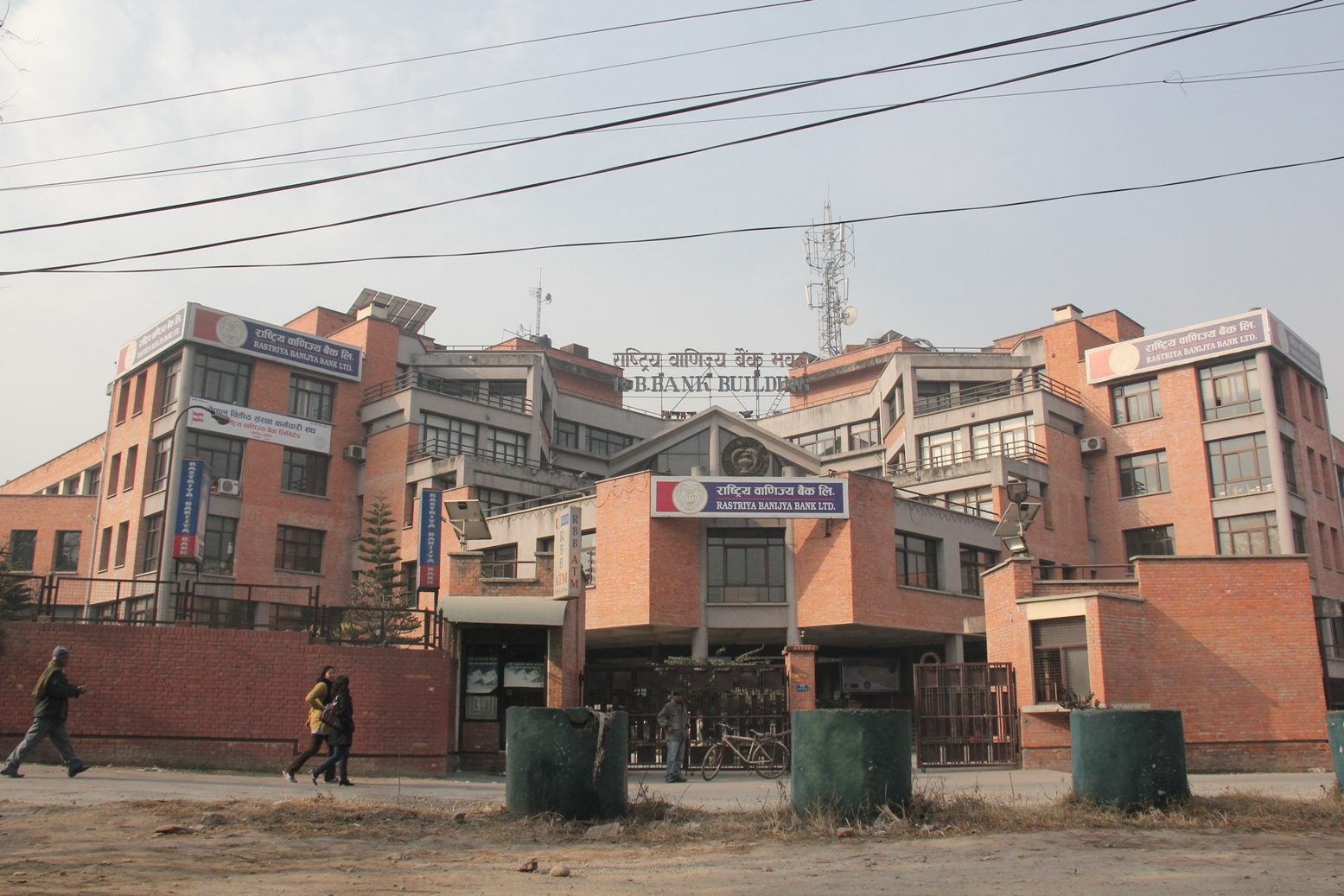
The league table shows how unevenly the pressure falls. Nabil Bank led with Rs 1.80bn, up 35.83% from Rs 1.33bn. Global IME Bank followed with Rs 1.69bn, up 4.07%, and Nepal Investment Mega Bank earned Rs 1.28bn, up 0.91%. Prime Commercial Bank made Rs 1.14bn, up 8.99%, and state-owned Rastriya Banijya Bank Rs 1.11bn, up 25.31%.
- NabilRs 1.8bn
- Global IMERs 1.69bn
- Nepal Investment MegaRs 1.28bn
- Prime CommercialRs 1.14bn
- Rastriya BanijyaRs 1.11bn
- NMBRs 1.03bn
- SanimaRs 1.03bn
- KumariRs 1.01bn
Source: Nepal Rastra Bank data
In percentage terms, Himalayan Bank grew fastest, lifting profit 55.13% to Rs 575.1m from Rs 370.7m. Sanima Bank was next, up 42.15% to Rs 1.03bn from Rs 721.5m. Everest Bank gained 7.88% to Rs 984.7m, Prabhu Bank 10.13% to Rs 744.5m, Machhapuchchhre Bank 8.17% to Rs 521.3m and Nepal SBI Bank 17.33% to Rs 415.9m.
Who is not
Seven commercial banks reported lower profit. Citizens Bank International fell 14.99% to Rs 474.0m, and state-owned Nepal Bank 12.45% to Rs 737.9m. Standard Chartered Bank Nepal, a foreign-owned lender usually seen as a steady earner, slipped 10.00% to Rs 479.0m. Laxmi Sunrise Bank lost 8.36% to Rs 892.6m, state-owned Agricultural Development Bank 6.33% to Rs 552.5m and Siddhartha Bank 0.99% to Rs 840.5m.
NIC Asia Bank, which once drove rapid expansion, earned Rs 499.0m, up just 0.79%.
State-owned banks did not move together: Rastriya Banijya rose 25.31%, while Nepal Bank and Agricultural Development Bank fell. State ownership is not a single story.
What to watch
First, whether credit demand revives. Without it, lending rates will stay under pressure and the margin squeeze is likely to continue. Second, the quality of the profit itself: how much comes from fees and recoveries, and how much from new lending. Third, asset quality as provisioning continues. Two months is a short window, and the full-year picture for 2026/27 will depend on whether borrowers return.
How this story was made: researched and written by The Standard’s desk with AI assistance, from the published reporting and official data credited below, and checked against those sources. Our standards.